

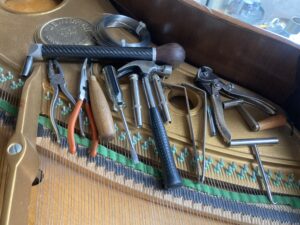
Tools required
Restringing a grand piano is one of the more dramatic jobs in piano restoration—and it requires some pretty unusual tools. In fact, if you didn’t know better, you might think a few of them came straight from a medieval torture chamber. But each one has a specific purpose, and together, they allow us to breathe new life into old and weary instruments.
At the moment, I’m in the middle of restringing a beautiful old Czechoslovakian Weinbach piano in Old Street. It’s a lovely instrument with a warm tone and solid build quality, and it deserves a second life. But like many older pianos, it’s reached the point where the original strings are no longer doing justice to the rest of the instrument. Time, tension, and countless hours of playing have taken their toll.
So what’s involved in the restringing process?
First, the old strings and tuning pins are carefully removed, often revealing decades of dust and hidden history underneath. This part of the job is fairly straightforward, though it does take time and a steady hand. Then comes the cleaning and inspection of the iron frame, pin block, and soundboard—crucial steps before any new strings go in.
Now to the fun part: the tools.
Some look like oversized crochet hooks, others like surgical instruments. There are stringing hooks, tuning levers, coil lifters, bearing tools, and even stringing cranks—each designed for a specific stage in the process. Winding the bass strings neatly and evenly onto the tuning pins takes practice, and getting the coils just right is both an art and a science. This is where precision really matters.
The Weinbach
The Weinbach has responded beautifully to the work so far. With each new string added and tuned, you start to hear the voice of the instrument coming back—clearer, more resonant, and full of potential.
Restringing is one of those hidden parts of piano restoration that many people don’t think about, but it makes a huge difference. It’s a slow, methodical process that rewards patience, skill, and the right set of tools (however medieval they may look!).
If you’d like to know more about the restringing process or you have a piano in need of some attention, feel free to get in touch.